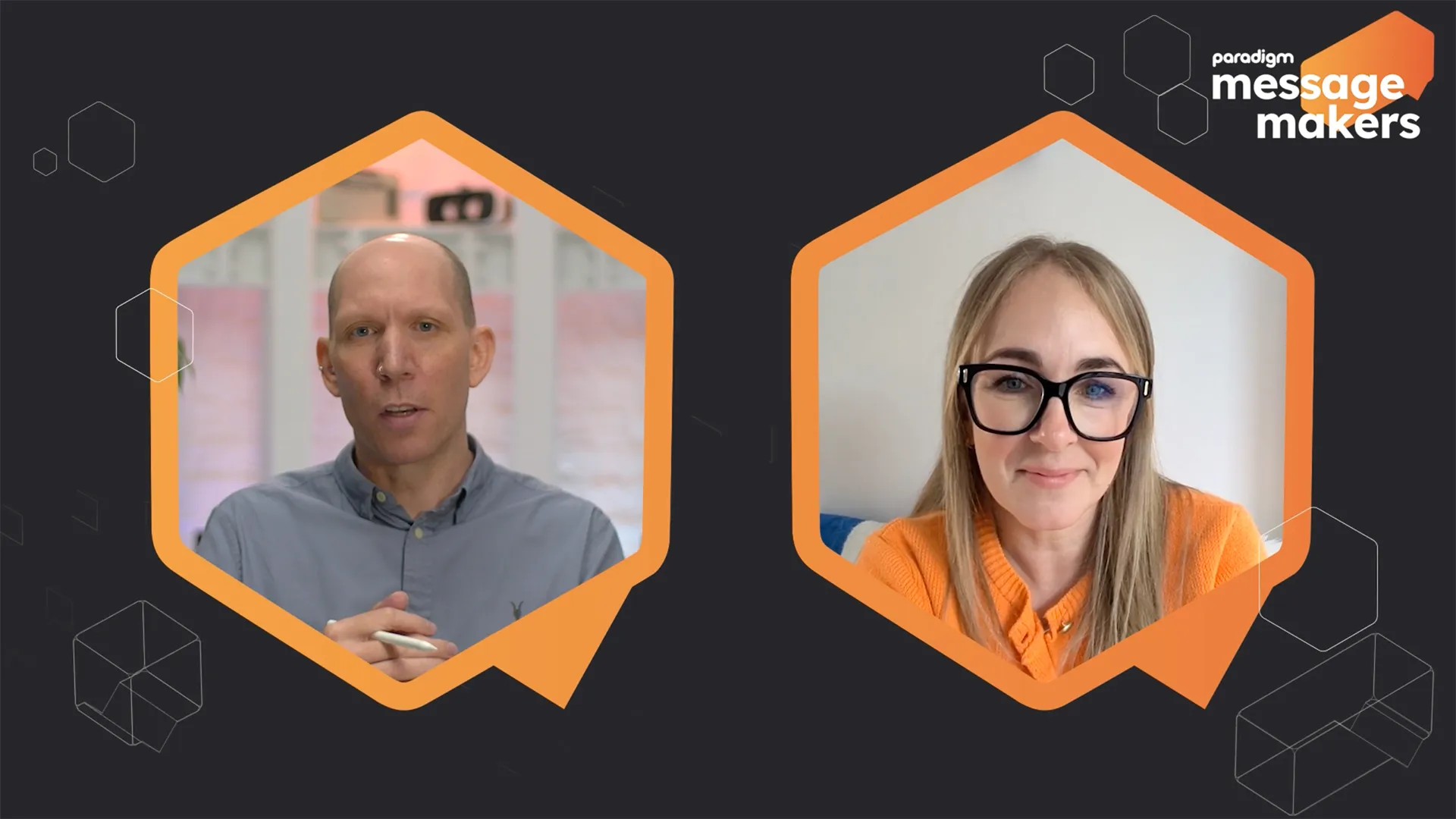
Transcript of a conversation with Owen Vittanuova, Managing Director at Paradigm, and Beth Fear, Senior Internal Communications Manager at Capgemini, exploring global comms, trust, empathy, and connecting people at scale.
Watch or listen on:



Hosted by:
Owen Vitannouva
Managing Director, Paradigm Creative
Guest speaker:
Beth Fear
Senior Internal Communications Manager, Capgemini
Owen:
Welcome to the first episode of Message Makers, where we dive into the insight, experience and expertise in the comms world. I'm really happy to be joined by Beth from Capgemini today.
So welcome, Beth. You've been in comms for a little while now. You've worked across a whole range of different industries, and I wonder if you could just give us a sense of that journey that you've been on.
From accidental beginnings to internal communications leadership.
Beth:
Sure. Absolutely. So I actually started out in internal communications by accident. I was doing a PR degree whilst working in a call centre at the time. And there was a gap when it came to engagement incentives in communication. So I put myself forward to plug that gap. And before I knew it, I was a communications adviser.
And as you can imagine, the head of communications at the time found out about me. Wasn't impressed that we'd invented this role. And then thankfully, a bit further down the line, she said that a vacancy had become available in a team. And did I want to go for that? And be a bit more aligned to the strategy and that side of things.
And I thought at the time, do you know what? Yes, I do. And I went for it. So here I am today. Having worked in a number of sectors, including financial, retail, engineering and I.T and I've also had a dabble in contracting as well.
Owen:
It's an interesting journey, and I started out working in a contact centre and kind of made my own role as well. So you're not the only one who's interested as well. With a with a PR degree, how much of that has been relevant through your career Beth?
Beth:
It's an interesting one because a lot of people ask me that question. I mean, the way that I try and position it is, I find that I'm not communicating, obviously with media. I'm communicating with employees, and I feel that there's a lot of similarities in terms of understanding your audience and into key messages and things like that. But I feel that the reputation side of it's an internal reputation rather than external reputation.
So I do find that I bring some of the theory, I would say, that I learned from my degree into what I do in internal comms.
Owen:
There's a lot of different paths into into a comms role, and I think there are so many similarities. And what we see a lot of, particularly with content and messaging, is kind of creating once and then using cross channels. So it's really interesting to hear from people with different backgrounds. So you kind of touched on the fact that you've dabbled in consulting.
And I think that leads us onto to where you are now at Capgemini. So maybe just tell us a little bit about that organisation. What does that role look like? And what what might people not realise about that organisation and maybe some of the nuances of communicating there?
Communicating at scale inside a global organisation.
Beth:
Yeah, of course. So I am currently the senior internal comms manager for the cloud infrastructure services sector. So it's like a global business line within Capgemini. The bit that people tend not to realise sometimes is how big Capgemini is. So in my area alone, there are 34,000 employees. Across the whole company, there's 340,000 employees. And just for those that may not know, Capgemini, it's a multinational information and information technology services and consulting company.
So we have such a wide variety of clients. We offer a lot of services, and it's one of those businesses where there is always something to learn. So it's been quite fascinating, on this journey so far. The current role I do is business partner in our Chief HR Officer, as well as coordinating our regional communications team.
In terms of what's different, what the challenges are, I think obviously it's such a large, complex organization with a really diverse workforce. And as I say, I find it fascinating in all honesty. But we obviously, as a comms team, have to regularly think about the tone, the language, the timing, the channels and working closely with stakeholders across the business so that we're making sure that obviously all our comms are aligned with our strategy.
Duplication is a big thing. There's so many different teams, obviously, across the 340,000 employees, all wanting to do kind of the best job we can, when it comes communications. And of course, anything we do has to resonate across the world.
It's not just what Beth in Yorkshire thinks. It's, you know, what does that mean for somebody in India? Egypt? America? Europe? So one of the things that people might not realise is just how much of our work is about enabling the dialog.
So, our CEO and our leaders here appreciate the value of, you know, creating space to connect. I think the connection and the clarity in a business like ours can make all the difference.
Owen:
And that's certainly something that I've seen a lot more of, is that communications has become a lot more about tile and a lot more about that connectivity and conversation. So it's interesting that that kind of that's a key focus in your business. Just thinking about that kind of journey that you've been on. You mentioned a few of the different industries that you've worked in.
So is there any similarities? Is there anything that's kind of stayed the same?
Clarity, trust and relevant across sectors.
Beth:
What I would say is that every industry I've worked in has its own like written language culture approach. So as an exampl, for construction, the communications we did had to be incredibly practical. There was a lot of focus on safety, logistics and making sure everything was a clear instruction.
Retail. As you can imagine, I'd say it was fast paced, very people centric. And obviously a big emphasis on the front line engagement of everyone obviously in the stores and things like that.
Financial services. Now, that was, an eye opener with all the layers of complexity around regulation and things like that that had to be considered.
And then I think about consultancy. I think that that was really about agility and innovation. And especially at Capgemini, there was a lot around, you know, needing to collaborate globally. So what would be the consistent?
I'd say across all of them, probably clarity, trust, relevance. I think that no matter what sector you work in, people want to understand what's going on, why it matters, how it affects them. And I guess they want to hear it in a way that feels human and authentic.
So I'd say that that's where I felt I've been consistent throughout the places I've worked.
Owen:
It's that thing of, yeah, big picture message and then and then kind of distilling it down to what does that mean for for me, I guess.
Beth:
Yeah.
Why audience mapping still matters.
Owen:
You've been in this industry a while, seeing lots of tools come and go. But what are the the tried and tested methods that you rely on, and have done for your entire career path?
Beth:
Well, yeah. There's no there's no shortage of tools in internal comms at the moment, is there? Because there's just so much kind of coming out there from videos and AI and podcasting materials and things like that. But I think, in all honesty, for me, the most effective methods are still the simple ones.
So I always come back to audience mapping and getting there. What what does it mean for me bit nailed. So I say, you know, who are you talking to? What I care about, how your message lands with them. Obviously that's fundamental.
So I remember, just giving a brief example here, back in the days when I worked for one of the supermarkets, it involved communicating with people that worked in our manufacturing sites. And I had no idea what it was like to work in an abattoir or on a produce line in a bakery, for example.
So I asked to go and visit, because I wanted to understand what a day in the life of our employees in those, working conditions was. And, you know, how did it affect them in the way that we communicated with them and what mattered to them?
So I'll spare you the details, but I'm so glad I did that because it really opened my eyes to how just doing comms in the way that I was used to wouldn't work for them, so it needed to be tailored. It needed to be unique and bespoke for them in their situation and their work environment.
And I guess that stuck with me ever since. You know, one size doesn't fit all when it comes to communications, and your audience is key.
Owen:
Is that something that you would would kind of approach manually or do you do you use a system or a tool to to facilitate that?
Beth:
It's just a simple table. I tend to try and use with the kind of project owners or stakeholders I'm working with. And it's, you know, who are our audience. And it's often that conversation of, don't say all employees, because we need to be more specific.
So, you know, can we work out, you know, what what part of this communication does a manager need to know? Versus, somebody working on the front line, for example. And I try an audience map it through. Who who are are key receivers of this communication? What do they need to know and why? And then I kind of try and encourage them to help me now work through this. It gets them thinking about it too. And you know, a lot of key messages come from doing that exercise.
A lot of people say, I just work out three messages or three key messages, but yes, we can have the generic key messages that work across the board, but we also need the messages that resonate with specific audiences and personas to.
Reaching hard-to-engage audiences.
Owen:
And that point around, hard to reach audiences. I started my career. You started your career in a contact centre, which is a very different set of pressures. Is there anything that you've tried, That's really worked? That's resonated with some of those, those kind of hard to reach audiences that you've, that you've worked with over the years?
Beth:
Face to face is always a winner, because obviously then that opens the opportunity to ask questions. It's here, and it's first hand. It's not being a cascaded past on message. Yeah, I always try where I can, especially if it's like a transformation change project to encourage some sort of face to face. And I know that these days there's the hybrid working side of things as well,
Especially in a global business like ours, the face to face side of things isn't always possible. But trying to do interactive team sessions, drop in sessions, coffee chats, that kind of thing where it's informal but intentional. That would always be my kind of go to.
Aligning global and regional communications.
Owen:
And you mentioned there, the global nature of the business and the challenges that sometimes presents, you know, just the logistics of time zones and distance between people. How do you overcome that? And what do you do when it comes to localization and cultural differences between those different territories?
Beth:
Yeah, this is something I'd say I'm still learning. You know, I joined Capgemini in 2019 and we've got an amazing regional, comms team. So when I say we sit in the global comms team, we've then got our regional comms team, which sit in each of the countries where we operate.
And from day one, you know, we've always had these regular team meetings where, you know, we would bring to the table what we're working on from a global perspective. We'd encourage them to share what's going on at a local perspective. Because it those conversations are key in terms of aligning, making sure there's no duplication.
But also we need to know that from our global standpoint, when we're sending out a message, is it going to resonate with people in their local culture, their local language? There's also things like legislation, union involvement and things like that. And even how people want to receive that information in different countries is different.
For example, in France, everything has to be translated into French. I can't speak French, so I often heavily rely on our regional comms lady to help me translate things. And obviously that comes with a okay, if I need to send this communication out, I need to think about my timings. Because not only have I got to do the the normal prepare, write, approve. I've also got to leave time for translation too for France.
Another example would be time zones obviously play a huge factor. Whenever we're planning an event, we've got to try and make sure that it works, that India versus America. I think we found our rhythm and routine with that now. But again, we've tried and tested a number of different times throughout the day.
But I think, yeah, it all comes down to just being intentional, about planning and being flexible I suppose to really collaborate with your stakeholders and your team across the world. Building strong relationships within the company has been the best thing I could have done.
Owen:
I think that that translation piece is so important. But just mentally adjusting for those timescales and timelines. I think we've worked to clients who we've got audiences in Canada and I think there's there's areas there where there's a legal requirement for translation. But obviously it's a different kind of dialect of French than in France as well.
So you need to need to bear that in mind, which I'm sure you've come across. And then in terms of working with those regional teams and the messages, you don't want to end up in a situation where the where the audiences got, you know, global messages, regional messages, team messages, kind of different hierarchies of messages.
How do you overcome that? Or is that something that's kind of a dynamic piece?
Beth:
In our regular meetings, we have like a planner where we can highlight, you know, what we're working on. Lots of people come on key dates for the dive from a global standpoint. We often ask for feedback. Is there anything that's going to get in the way of this being a success locally? Have you got any big events planned at a country level? Is there anything else that you're aware of?
There's national days of celebration across the world as well, you know, bank holidays and things like that. So it's just about working really collaboratively as a team.
In addition to that, whenever we do work on a global campaign, we try and provide that toolkit where we hand it over, and then they can adapt and make it work locally for their audience.
So you know what channels are more effective in their country? Does this word in this language work on this topic for your country, in your culture? So I think the toolkit has been a really good way of us overcoming some of those barriers, or maybe resistance, to some of some of the messages we try to push out.
But we also do a lot around involving local voices, getting their inputs on some of the events that we want to run, because we're quite passionate about being inclusive. We want everyone to bring their own self to work. And we want to hear those voices from across the world as well, because we've got a lot to learn from each other.
So whenever we're developing a campaign or an announcement, getting that regional input from colleagues helps us spot potential pitfalls, but it also helps us build something really inclusive. Which then, again resonates better with people across the world.
Owen:
So it's that kind of collaborative planning and then and then toolkits that can be localised and regionalised to the different audiences that kind of the key takeaways, I think.
Beth:
And obviously, having a collaborative regional comms team that we can tap into, helps us bring that to life.
Owen:
I ended up downloading a little widget, for my computer when we're working on international projects so I can kind of have visibility of the time zone of the area that we're working with. Because it just it just helps you kind of get into that mindset.
And I think you mentioned events a few times in kind of trying to find the right point to schedule those during the day. I don't think there is any any right answer for that.
We've done various projects where it's either picking the best day, the best time that works for the most people, or running it a couple of different times and making things available on replay. So I don't know if those are some of the tactics that you've used as well.
Beth:
Yeah, we've got some events where we don't record the course they're meant to be these Speak Freely sessions where we want people to be able to ask a question. You know, we want people to speak freely about the topic. And we don't often record those, and so they feel quite exclusive in a way. And they get good attendance.
But then, where we've got the big strategic messages, the town halls, the leadership, kind of announcements. We do recall those just to make sure that if for any reason people can't make it on that day or that time, that they've got the opportunity to listen back.
And I think, you know, we work quite heavily with clients and sometimes people have commitments with clients as well. So we don't want to take them away from delivering, a service for our clients either. So yeah, we have to be mindful of all those things.
Owen:
It's interesting the speak freely sessions. Is that is that the terminology you use with the audience? Are they very aware of when things are and aren't being recorded?
Creating space for open and inclusive dialogue.
Beth:
Yep, yep. So it's part of an initiative we're doing around inclusion, and obviously it's a huge topic. We are quite passionate about being inclusive as a business. And so one of the initiatives that's being led in our area at the moment is this Speak Freely campaign, where we will come up with a theme based on feedback from our engagement survey.
You know, what people are sharing on there that we maybe need to dig a bit deeper on. And we'll kind of open the lid on it and just say, you know, come to this session, we want to talk about this topic. It won't be recorded. Ask questions, share your voice, and your opinions, and let's see where we got to. We often take things away from those sessions. If needed, we escalate. If we can influence and change things we do. Or if it needs a bigger, further discussion, we plan what that looks like as well.
Owen:
And how are those being received, or is it is it early days?
Beth:
I think there's that trust element of people. Are you sure can ask that question? Am I okay to share my personal view? And I think the more that we do them and the more that people see that there's no repercussions as such, I think they'll become more and more popular.
Owen:
I'd be really interested to see how that goes. You're making a space for people to be able to speak freely, and it sounds like a really, really powerful tool. And thinking about current challenges and opportunities that you're facing, what is the one biggest comms challenge that you're facing right now Beth?
Managing constant change in large organisations.
Beth:
I'd say, probably managing constant change. You know, whether it's organisational shifts, new ways of working, new tech, return to office, all the expectations from our people, there's just always something moving isn't there at the moment. And I think our job is obviously to help people make sense of it, which I love.
But I also feel the pressure. I guess it's finding the right balance with how how we can continue to communicate effectively on all these changing, moving subjects, and giving people enough clarity and direction without overwhelming them as such.
The role of AI in internal communications.
Owen:
So we can't have a conversation about comms without touching on AI. And I know when we spoke before, you mentioned the Capgemini are doing a lot of work with clients on AI as well. So is that filtering through to the work you do in the comms team? Are you experimenting with it? Have you found any successes anywhere?
Beth:
Yeah. I have blogged a bit about this on LinkedIn actually recently. It's definitely my new creative comms buddy. Or is it creative comms buddy or is it my doer? I do the thinking I does the doing, I think is how I'm positioning it at the moment. But yeah, to be honest, I've used it for all sorts in in my current role.
I think one of the things I enjoy the most is push. I ask it to push my thinking. So, for example, if I was working on a strategy or trying to to shift how to communicate, I'd ask it things like, how how could I make this more impactful for a non-technical audience? Or, you know, challenge this idea. What am I missing?
There's various prompts that I've kind of got used to giving it, to challenge the norm in terms of what I always go to in my approach to internal comms. But yes, as a business for Capgemini, there's a really strong global focus on responsible AI.
So, we've got access to approved tools and a huge amount of training to help us make sure that, we're using them safely and effectively. And I guess the emphasis is on using AI to support our work, not replace it. And, alongside that, making sure that we're thinking about the ethics, data privacy and our long term impact, really.
Measuring outcomes, not just outputs.
Owen:
Measurement and ROI are always, kind of topics that come up. And I think what I've found over the years is, it can often be a bit of an afterthought, as in, okay we've done all of the communicating, whatever that might look like, whatever channels we've used, whatever the messages are, now how do we measure it. Have you kind of cracked the nut of measurement at Capgemini?Have you got any any secret silver bullets to share?
Beth:
For me personally, I would say I've traditionally focused on things like attendance at events, read rates, likes, clicks, all of those things. But I guess where I'm at now, is they only tell part of the story. And so what I'm trying to do is shift towards measuring outcomes rather than just outputs, these days.
So instead of asking, did people read this? I'm trying to ask, did it change anything? What the behaviour did it change?
Owen:
I think that's a very important point. It's establishing at the start, isn't it, what is the measure of success? What is the behaviour you want to shift? And if you don't know that beforehand, then firstly, should you be communicating it? But secondly, how do you how do you measure that?
And I think, as well, you can't measure everything. I think I think there's this too much of a focus on that. And I've heard stories before, I'm sure you've come across this. If you trying to communicate around, one topic, but there's issues around pension or pay or something that's really emotive, one can bleed over into the other. So each piece of communication doesn't exist in isolation.
So, moving on then, is there a campaign or a project or a piece of communication from your history, that you're particularly proud of, that you that you can share with everyone?
Designing a people-centred communications hub.
Beth:
I'm going to actually talk about something I've done just recently, actually, because I think it's a really nice piece of work, and I'm not trying to blow my own trumpet here, But, I've just recently launched a new People hub. It basically started as a really simple idea based on feedback that I was hearing from people, not knowing where to find certain people related information.
So, things that matter to people in their career, you know, learning, career growth, wellbeing, CSR, all those important topics. So I just kind of started to think a bit about, what does that mean? What does that look like? How could we make this better? And, I wanted to introduce a clear, easy to navigate space where our global employees could find the things that matter to them.
And that's where It began really. I started to design something, to try and simplify this experience and give people that global lens on our H.R. priorities. But at the same time, obviously still having to respect the local tools and policies that existed. So this wasn't about replacing what was already there, because that would have been huge.
It was more around connecting the dots and making things easier to find for people. So, it was a bit of a challenge to start with, because I'd never built a space like that myself before. But, I got a few of the team involved, and we quickly created this basic structure on SharePoint. And then I spent time working on the content with our H.R. leadership team.
And it was a real, kind of, roll your sleeves up and get stuck in moment for me as well, because I wasn't just writing about this or promoting it, I was building it. I was creating it at the same time. And I guess that kind of, reminded me how powerful communications can be when it's rooted in empathy like that. And I understood the need of people because I myself have struggled in some instances to find what I was looking for.
Anyway, this launched in July. And we're seeing really great results already. So it's the early days, but we're getting really good traction on the site. And we've received some qualitative feedback to, around, this is great, I can now find what I'm looking for. I just have to come here and it's like a one stop shop. And so now, we're looking at what phase two of that could look like, so that we continue to make it work smarter for our people.
Owen:
It almost calls back to that audience mapping point that you made earlier around understanding what people's need is and then finding a way to solve that, rather than communicating what you think is the right solution. So there's a real kind of thread in your approach, I think.
Beth:
Definitely, and I think it's made me realise that sometimes the best communications work can happen when you step out of the traditional comms lane as well. I've said it wasn't just about me writing and promoting this. I was building it, I was shaping it with people, to make sure it worked and it had an impact, it had an effect on people. So, yeah, I think I'd say the main thing I've learned from doing that would be to stay curious and just ask questions and dive a bit deeper.
Owen:
I'm really lucky to kind of go in and out of lots of different businesses. And I'm quite the most powerful thing is to ask the silly question of, well, why are you doing it like that? Why you're approaching you like that? And I think, yeah, sometimes stepping outside again, that different perspective can be super powerful.
We are going to get controversial now. So we've said earlier, there's lots of tools, a plethora of tools. More channels than you can shake a stick at. And those have kind of only only grown over recent years. If you could switch off one channel or one activity, just stop, doing something, what would it be and why?
When to stop doing what no longer adds value.
Beth:
I'm going to say, probably, it's nothing specific, but I probably say I'd stop any channel or activity that has become more of a habit than a purpose. Sometimes we keep things going because they've always been there, like a newsletter or a podcast or a weekly update. If it's not adding value, or sparking that conversation, or having an impact, I guess it's worth asking whether it's still serving a purpose.
So I've stopped those things, and I don't necessarily know what that is for me right now, but that would be it.
Owen:
Again, going back to your kind of audience mapping, the other side of that is channel mapping. That kind of channel audit piece. I think people often view that as a big kind of thing. But I think, having a regular ongoing appraisal of the channels that you've got and whether they're still fit for purpose, is part of making sure that everybody can access the information that they need in different ways.
But if you end up with a channel, that's there just because it's always been there, actually having the bravery to stand up and go, why are we doing that? Should we approach it differently? Should we turn it off? I think that that can be really powerful.
Beth:
Yeah, we do like a quarterly audit on all our channels where we look at the traction. There's no point carrying on doing a newsletter if nobody's actually clicking on it and reading it. There needs to be another way of getting that information across that's more impactful. So yeah, channels are definitely something that are a big, big part of what we do.
Owen:
That data must be incredibly rich then, if you're auditing on a quarterly basis. Are there any trends or anything really interesting that's come out that that you've seen?
Beth:
Something that was really fascinating for us, which we're still trying to get our heads around a little bit, is we kind of tried to turn to more digital ways of communicating. So stepping away from email, and trialing these short, snappy like videos. We've only done a pilot so far of, you know, rather than sending this in an email, what would it look like as a TikTok style video?
And for some, they loved it, but for quite a lot of our audience they weren't sure. And we found that quite interesting in terms of we thought that that would be a huge hit. So we're just trying to unpick that a little bit and understand, you know, what kind of video would you like, if we did go down that route a bit?
The importance of curiosity in communications.
Owen:
Now I'm going to kind of try and bring everything together because you've mentioned a few things. You mentioned audience mapping, you've mentioned kind of keeping a track of your channels. You've mentioned making, spaces to connect. What would be the key thing that you've learned over your career in comms?
Beth:
I'd say start with curiosity. Ask why? I love to do that. And it reminds me of a determined toddler when I go in and just go, why? Why? Why?
Never be afraid to ask questions is the one thing I've taken away. You know, it's okay to be vulnerable as well. Whether it's challenging how we say something, or digging into what people really want to hear. Or even if its asking myself, a question around, could I be clearer? Could I be kinder or more useful in how I'm communicating?
I think curiosity is definitely what's kept me learning, and listening, and wanting to improve.
Owen:
Yeah, I think that can be super powerful. I really appreciate you spending the time. It's been a it's been a really interesting conversation. I've really enjoyed it. Thank you for coming on Beth.
Beth:
Thanks so much. It's been a pleasure.
Owen:
That's it for this episode of Message Makers. Thanks so much to Beth for joining me and sharing her insight. If you've got any thoughts, questions or suggestions for guests, please do get in touch and we'll be back soon with more conversations from across the world of comms.