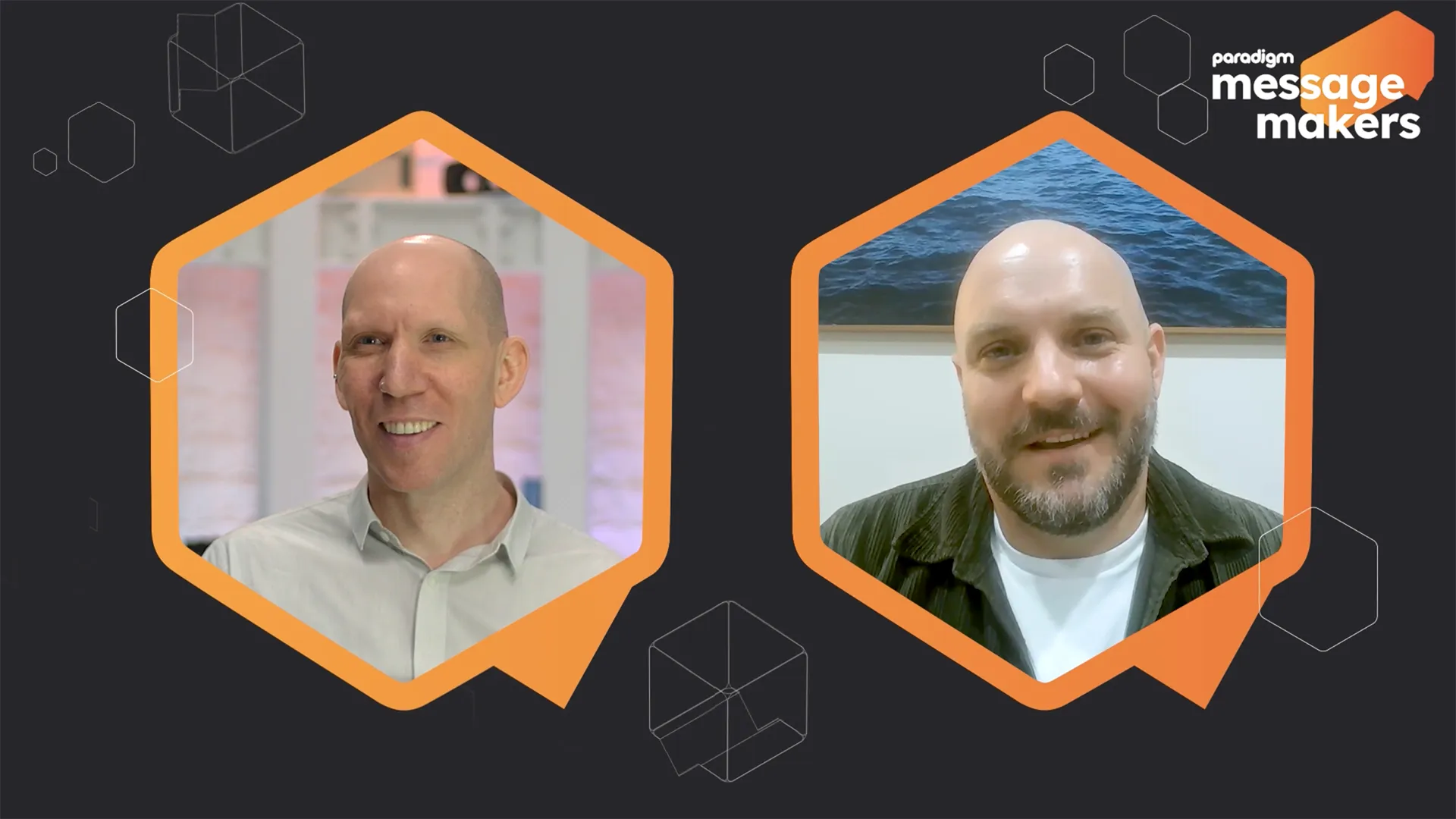
Transcript of a conversation with Owen Vittanuova, Managing Director at Paradigm, and Iain Lumsden, Head of Internal Communications at ING Australia, on culture, global connection, inclusion, and digital-first communications.
Watch or listen on:



Hosted by:
Owen Vitannouva
Managing Director, Paradigm Creative
Guest speaker:
Iain Lumdsen
Head of Events, Activations and Social Impact, ING Australia
Owen:
Hello and welcome to Message Makers, where we dive into the knowledge, insight and expertise that's shaping the comms world. Today I'm joined by Ian Lumsden from ING in Australia. Great to have you with us Ian. Maybe just give us an overview of your journey and how you ended up working at ING in Australia.
From the UK to leading internal communications in Australia.
Iain:
So I've been in their comms profession I guess, since probably, the last 20 years now. It's a bit weird when you say it out loud. Makes me feel quite old. Started my career at financial services, back in just a couple of years after university.
Worked at O2 where I obviously met you, and a lot of other wonderful people. Spent a lot of time there, then worked at a little video production agency called paradigm for a while.
Moved to Rolls-Royce and then made the move to Sydney and been living here for the past nine years now, which is quite scary.
It's been a mix of roles, covering business partnering, content, channels, and now leading a team, leading internal comms at events. Mainly internal comms and events has been at the center of the heart of what I've been doing.
Owen:
ING, for the international audience that may not know, they are a bank. Maybe you can tell us a little bit about what they're like as an employer and as as an organisation?
Building a challenger brand that doesn’t feel like a bank.
Iain:
It was one of the first internet only banks, high interest savings account. No bank branches. So it was quite, you know, disruptive and revolutionary at the time and definitely seen as a challenger brand. And still is, in terms of the brand itself, it doesn't feel like Bank, which is one of the reasons why I love it.
It actually feels more like telco right now. When we used to work at O2, it does remind me of the kind of culture of that place, the excitement of building something a bit different. The brand itself is quite playful that we call it wonky.
So we try and do everything, from our advertising to our tone of voice, to feel a bit different from a normal bank. It does give you that license to be a little bit more playful and a little bit more sort of irreverent sometimes, while still maintaining some degree of professionalism in terms of some of the messages that you're trying to get across.
You stick around for long enough, you know pretty much most of the people that work here, which is really nice and also helps you do your job as well. So it's one of the main reasons why I've stayed there for so long and continue to love what I do.
Owen:
A lot of comms comes down to that, what's in it for me kind of thing. And I guess being part of a large global organisation, the opportunities and stability that brings.
Connecting local teams to global strategy.
Iain:
Absolutely. There's heaps and heaps of benefits. We really try and help our leaders, but also people managers contextualise what their teams do and how that kind of fits into the broader strategy. So it's very much about recognising the wins, explaining to them how it supports our different pillars to the strategy, giving them templates, all those types of things.
We have people from the group, particularly the management board based in Amsterdam, that will come over maybe once every year or 18 months. They'll meet people. They'll do various different, interactions with some of the teams. And that also helps to really connect the dots between what the global strategy is, how Australia fits into that, where we do really well and where we need to focus as well.
Owen:
You spent the first part of your career working in the UK, now living and working in Australia. Are there any differences between those two audiences culturally? Working at an Australian business? Or is it very much the same? What's that experience been like?
Cultural diversity and global perspective in the workplace.
Iain:
I think fundamentally, comms is comms when you're when you're talking to an audience. I think the fundamentals are very, very much the same wherever you are. One of the things that I probably didn't appreciate until I got here, was the real melting pot of a diversity around the audiences that you have in society in general. But obviously that's reflected in the workplace as well.
So, just a couple of stats. We did a survey last year, and I think we have more than 60 different cultural backgrounds, from people that filled in a survey to say, this is where I'm from. Originally, we had more than 50 languages spoken at the bank as well.
English is everyone's language that we converse in. But I think it just kind of shows all the real differences. Certainly from my experience working in parts of the UK, you would have diversity, but not on the same scale. And I think that was certainly something that surprised me a little bit, but it's also incredible.
What you can learn from the people that you work with, the stories that you can share and how you can help, you know, bring people together to help people better understand each other's coaches is is quite powerful. And I think that speaks to, probably the most profound difference that I've seen.
But a brilliant one as well.
Owen:
Spoken to a few people who work in global organisations and there's that acknowledgment of communicating with different cultures with such a multicultural group of employees within the bank. Does that make it easier being part of a global organisation?
Iain:
Yeah. Because I think at any given time, we're going to have people from all around the world that work for us that bring those perspectives, those ideas, those ways of working.
Whether you've got someone from the Netherlands that's working over as a short term assignment, or if you've got a student from Germany, for example, or whatever that looks like. You get all these different kind of ideas and perspectives that really help to build a much more rounded, stronger, more complete team in the way that they think. It's encouraged to challenge ideas and have constructive debates.
Owen:
In terms of work in Australia, is that diversity of thought, diversity of contributors, is that one of the biggest differences? Or has there been any other differences that you've experienced moving and working from the UK to Australia?
Culture, brand and leadership as the real differentiators.
Iain:
I think fundamentally where things are different, it all comes down to the place that you work. So it all comes down to brand, it comes down to culture, it comes down to leadership. So these are the kind of things that I think, really dictate the differences in a company, whether it's based in Australia or based in the UK or wherever it is in the world.
And I think that the culture and the brand is one that is a bit more relaxed.
Owen:
You mentioned diversity and inclusion as being important to you and important to ING. I'm speaking to a lot of people at the moment, and there seems to been a shift from diversity and inclusion to wellbeing and inclusion. There's a lot of international pressures on international businesses around diversity and inclusion and some of those programs.
Is that something that you've felt and seen at ING, or has that not really had an effect on that business this year?
Sustaining commitment to diversity and inclusion.
Iain:
Look, I think we've always fully supported diversity and inclusion. And that's never changed. I think the commitment that the company has is one of the main things that people are proud of the most.
In fact, it was a question that came up at one of our strategy updates at the beginning of the year where someone said "with everything that's happening in the news right now, will there be a change in the focus?" And the answer from the leadership was absolutely not. We remain 100% committed. We know that that's one of our differentiators.
I think that was a real, important, moment in time for a lot of people to hear that. And indeed, we have a large number of employee networks that are all employee run.
They're not run by executives or anything like that. So, whether it's LGBTQ, whether it's gender equality, whether it's neurodiversity, whether it's parents and carers, we have groups that are set up to drive positive outcomes in all of those areas and more.
And I think that's really nice because those people have a day job, and they do this as their kind of side hustle in terms of a side of desk role.
But they do it because they believe in it. They they do it because they love it. And they want to be part of something bigger. And I think that's where the magic is.
AI as a productivity partner, not a replacement.
Owen:
We can't have a conversation about comms without touching on AI. I know you've been doing a lot of experimentation in that area. You've run some, focus groups and panels on that. Can you talk to me a little bit about the experimentation that you've been doing in that space and what impact that's had.
Iain:
I think a lot of people still aren't quite sure. I think there's still a fear about it as well, in terms of what am I allowed to do? We have Copilot at work, and we're doing a lot of work to train people on how to get the most out of Copilot. I use it for a range of different things.
One of my favourite things is when someone sends me an email, and it's a really big success that that someone wants a story written up for the intranet. But it's written in really complex jargon and it's been folded on five times because it's part of an email chain.
I just chuck it into copilot and say, please refine this, 350 words, hit these beats. I give it a few prompts just to make sure that it's on message and it just spits out something. It's not perfect, but it's probably about 65-70% there. And that's good enough. I'll just make those changes afterwards.
So I think for comms people it's certainly not a silver bullet. There's nothing better than sitting in a room with a few like minded people and just bouncing ideas off each other, and we've done that before, and I really appreciate that.
I've done it with other people that we've worked with before. And I think the magic that happens when you spark ideas from each other, or you say, oh no, I did that and this is what I learned. I think that's something that AI can't replicate. There's always a need for that kind of human interaction that comes through ideation.
And in order to keep things fresh and interesting and engaging and feeling new.
Owen:
AI can be a great partner, or a great tool to kind of bounce things off, but it doesn't get excited. I know when you and I have had those those conversations before and we have a great idea. Like excited. Yeah. Yes. Let's do this and that. That kind of enthusiasm and excitement is, is infectious and can lead to those great ideas and those builds I think.
And yeah, you just don't get that from an AI copilot.
Iain:
Exactly. And I think we both know that where you can translate that excitement of an idea into an execution an installation, an experience, an interface, an outcome of some description. I think that's where the person or the people that you're trying to connect with, that's where they get the most value. That's when they talk about it afterwards. That's when they remember it.
Because you've really put in the hard yards to try and create something that's the best it can possibly be. I don't know how many people remember emails that I wrote 3 or 4 months ago, but they still remember an event I put on last year because they laughed, they had a good time, and they were with their friends.
And the content was interesting and dynamic - they weren't bored and things like that. So I think that's where, when you get it right and you think about what the experience for people is, how am I going to make this feel good for them? Then that's when you when you've done your job the best.
Owen:
So do you think people are expecting too much from AI? Do you think they don't know what to expect? Where do you think that's going to going to land In the end?
Iain:
I think it's too early to tell. I know that's probably a cliche answer, but I do think it's too early to tell. I think the people that will be the most successful will understand how to use it as an aid to what they do.
In terms of driving productivity and simplifying the way they do certain tasks so that they can spend more time on probably more sophisticated, more complicated, tasks that require a little bit more human thought.
Whether that's strategising, whether that's creative thinking, whatever that looks like. I think, for me, I would love more time to think creatively, as I'm sure we all would.
Sometimes you get bogged down in the BAU and I think that's where AI will play a critical role. Really just getting rid of that time spent in the minutia, so that you can elevate yourself and think more broadly about the strategy and plan ahead.
Owen:
Some of these are really just starting out. Where would you say is a good place for somebody to start, if they're just really overawed by it?
Where to start with AI experimentation.
Iain:
I think it starts with, what problem are you trying to solve? So if you've got a business challenge, or if you've got something that you really want to crack, like you need to do more of X, or there's a focus in terms of driving awareness of a particular topic. Then start there.
You can even start by saying give me a starting guide to using copilot and see what it does. I'm sure it would write a little intro course for you, but there's so many things out there. There's so many courses, whether it's on LinkedIn or in other free online resources that are available for you.
I see people on my LinkedIn profile all the time popping up with accreditations for new AI and courses that they've done. I think it's great. I think it's really important to just push yourself, and make sure that you're trying to stay ahead, as much as you can, in terms of this field, because it is here to stay.
I was part of a round table discussion with some communications professionals a few weeks ago, and we were all talking about how we're using it. And it was all very similar in terms of some of the some of the examples that we touched on.
Whether it's writing whitepapers, or briefing notes for leaders, or whether it's summarising case studies, articles, data points. It was all very similar, which is great, because you kind of think good. Because we're all at the same level, we're all running at the same kind of pace at the moment.
I think that kind of validation from your peers and that sharing best practices is always great. One of the things that I think is dangerous for a communicator, particularly if you're in a small team, is if you feel like you're the you're the only one going through something. Chances are, that people are going through something very similar in every company. Whether it's the same challenges, whether they're having the same successes.
So I always encourage people to reach out to their networks, build their networks, go to meet ups. If there isn't a make up in your area, start one. Why not? I know that you guys do that really well in the region as well.
I've been part of those conversations, and I think that's a really powerful way to bring people together over these topics, take away some of their fear about it and allow people a platform to say, this is how I'm using it or this is how I'm not using it. I don't know where to start. And I think people generally, particularly in the comms community, are very supportive.
Owen:
It's really, really interesting. I think for me, it falls into a couple of different categories.
There's stuff that saves time, like the meeting note taking and summarisation, which just means I don't have to spend the meeting scribbling. It's a lot easier to go back, recall information and then summarise in documents and emails - pulling some of that stuff together.
But then the other side is that kind of exploring, challenging, kind of side to it as well. What if I do this? How about this? What do you know about this? That summarising research, but then also feeding in: okay, here's what I'm thinking of doing, what what are some of the questions that I might get? What are some of the challenges I might get on that? Just using it as a foil to challenge on.
AI agents and human-centred design.
I had a really good idea, from a really good suggestion from somebody that I was chatting to the other day about using copilot to build an agent around an event.
So feeding in all the documentation to do with the event - the running order, the speaker notes, as the event went on, the transcripts of the presentations and creating an agent that is trained on the content of that event. So people can interrogate that. So when's the session around this? Who's going to talk about this topic?
And then as the event goes on, being able to ask questions about what everybody's spoken about, summarise that and keep it all in one event agent - which was something I'd never thought of. As soon as they explained it, it seemed seemed like it could be really valuable.
Iain:
It's incredible. What a great idea. What a great add on for a digital experience, as part of an in-person event right? And I think that's where, again, this creative thinking around that technology exists. People are doing it now. And what a brilliant way to wrap it all together.
You could you can create some kind of internal comms agent, for want of a better word. When people onboard to a company for the first time, you could potentially have an agent that shows you around the internal comms platforms, how to engage and what each channel does?
That would be super useful. I know that's something that a lot of people, particularly when they start work somewhere, they struggle with. Where do I go for this and where do I go for that? And so it's building that capability - whether it's a HR joint partnership, or it's something that comms were to look at.
I think the opportunities are endless. And I think at the core of it, it's about thinking about that human centered design. What is it that people need or want? What's going to add value? and how do we deliver this in a really seamless simple way, so that they don't have to go and look for the information?
They can just tap something or just ask a question or a prompt, and then they'll get all the information that they need. So I think designing it with a human in mind is is absolutely key.
Owen:
Since we've spoken about AI, we've mentioned AI agents. And I guess my understanding of it, having played with a few of them, It's kind of, it's an AI interface that's designed with a specific purpose that has, resources that that agent can tap into. So in the use case of the event agent, it would be an agent that is given the task of communicating around the event, some example questions, but then has that data that specifically relates to that event programed into it.
So it's kind of AI interfaces with specific use cases and specific data. And you mentioned using Copilot, using things ethically and securely. It's kind of making sure you're using the right tools for that, to make sure that the information isn't getting out into the wider world, I suppose.
Iain:
Absolutely. And again, I think it's that next stage of how do you bring these things to life and use them in really interesting ways? In terms of the event space, I think that's a huge, huge opportunity.
Owen:
We mentioned events a few times. And I know you said you don't think people remember the the emails that you bring. I've read some of your emails. You write pretty good emails. But, talk to me about some of the events that you were on. Are there any that stand out for you as having run them and got that that feedback from the audience as well?
Reimagining events to create memorable experiences.
Iain:
Yeah. Look, I think anytime you try something new, is where for me, I get the most joy. I go back to an event that we both worked on. Well, it was actually your baby when I first joined O2, and we did a superfans awards, if you remember and cast your mind back to, I think it was 2010.
I think we had about 800 people that attended, but we also live streamed it for those that couldn't watch it in person. And it was a full, full production. I remember going backstage and just seeing you and about, I don't know how many crew or how many TV screens we had.
But just the fact that we had me as one of the hosts, kind of walk around interviewing people. Then we had a host in the back as well as that kind of anchor and just the layers of complexity, but also the level of production value that came with it.
It just felt like an incredibly professional, really entertaining production, whilst showcasing the best of the O2 coach. Going and having a laugh and talking to our executives, all whilst basically, running the risk with live TV that something could go wrong any given moment.
There was a few little glitches and we kind of just stumbled through them. But I think for me that was a really good example of - we could have just a normal awards night. It could have just been a really safe, very controlled. Everyone sit down.
But instead we did something very different. And I think for me, that's where the magic of events, that's where it works best. And that's where people will walk away afterwards and go, wow, that was really fun.
Because there's moments where they're unexpected, there's surprises. I don't know what your thoughts were on that, but it's certainly one of my highlights.
Owen:
I just remember lying on my back, passing your cue cards while you did the robot while we were filming for time at one point. So definitely memorable from from that point of view. I hope the audience found it memorable as well.
But, I know we've spoken about a few of the events that you've run at ING as well, and some of the different formats that you run there, and some of the opportunities that you've had with the newsreader update as well.
So I don't know if there's anything more recent that you can talk to, that that's really stood out for the audience?
Iain:
Yeah, there's testament to everybody that works at the bank that's involved in events, whether it's actually managing the events, or being part of the events on stage, being a presenter. One of the things we do well is, is really thinking about how to reimagine how we do things.
We like to blow things up every couple of years and try again and do something different. And I think it's really important to do that, because otherwise it can feel a little bit stale after a while. And so, at the start of last year, we actually signed a media partnership with one of the local TV stations in Australia.
We've got this media partnership with the Breakfast TV show, that we kind of have a link in to. Wouldn't it be great if we brought that idea onto stage as part of our mid-year conference, kind of celebration? And that's where this new format was born.
And again, it was a lot of fun to put it together. It was a bit of a risk. It was a bit of a step into the unknown, because we were playing with a news desk kind of segment, plus a couple of different on the couch interviews. We actually had the great ING Bake Off as a bit of fun during it. And then we had lots of different video content, interspliced throughout the transitions.
We even had the the CFO doing the weather forecast, but it was the economic weather forecast. So it was very carefully scripted. But he had a big weather map behind him. And it was very, very funny. And I think those types of ideas, they are obviously a lot riskier because it is a step into the unknown.
But it was deeply rooted in the brand in terms of the look and feel and the way that we did it. There were still some key business messages that we made sure were included. So it wasn't just a silly 90 minute show. It was very much a tie back to strategic priorities, but done in a way that was a bit different that remained true to the brand.
So it wasn't full of senior leaders doing presentations, as you know, the kind how conferences usually look. It was actually people that are mid-level, and even juniors, that were actually on stage talking about the things that they were doing, how they were helping customers and some of the programs and projects that they were really happy about.
And again, it's a bit of a risk because these people are not seasoned, media-trained, individuals. But with the right level of coaching, rehearsals, all that kind of stuff, they all performed brilliantly.
And I think it was just thinking of all those different ingredients, how it all comes together, the look and the feel, the staging, the production, the rigging, the lighting, all of that, just really helped to make it feel new, fresh, exciting and different. Whilst making sure that the you've got that audience interaction connection back to the audience as well. Which is so key to make them keep coming back.
And I think that's the, that's the ongoing challenge for anyone that works in comms and events. How do you keep things fresh and interesting?
Owen:
And fresh and interesting without becoming gimmicky? And you mentioned that drawing back to the strategy each time. I guess that's part of what we do as well, is asking how does this support the message? How does this support the strategy? Is that how you walk that tightrope between fresh and interesting without veering into too gimmicky?
Walking the line between fresh and gimmicky.
Iain:
That's exactly it. And I think, for me, humour is really important. There is a fine line between humour and being gimmicky. I think if you understand your audience, understand the cultural nuances of the audience that you're communicating to, then you should be all right.
You don't want to go too cheesy with stuff, because I think people can switch off and they feel disconnected because it's not genuine. But where you really think about the content, how that's going to land with the audience, test it out with people beforehand. I love to test it out with people.
Just get a couple of people in a room and just say, hey, I've got this idea. We're going to try and do this. What do you think? And sometimes they'll be like, yeah, love it. It's brilliant. And other times they'll think, it's a little bit too wacky. And you might just want to reign it in a little bit.
And that's all right as well, because I'd rather have that feedback upfront so that I can iterate, refine, and make sure that what goes out, in terms of the final production is, is fit for purpose.
Owen:
You and I have worked in comms since before we both had hair. What stayed the same? What's changed? What are those key things that are just timeless in your opinion?
What has changed, and what hasn’t, in communications.
Iain:
The same things interest people 20 years ago that interests them now. I find it fascinating when you do a story on somebody and some of their achievements, or what they do outside of work, or just lift the lid on some of the people that work in your organisation.
The other things that often get the most clicks, the most views, is because people are genuinely really interested in what the people are like and what they do.
And so I think that human interest in celebrating people, spotlighting people that are doing great things, whether it's within the workforce, or whether it's in their communities and more broadly, I think that has never changed.
And I think that's one of the things that I love. If I was to think about something that's changed, obviously we talked about technology and the the rate of change in terms of some of the tools and applications that are available.
I mean, when we started out in comms, it was before iPhones right? So yeah, I think technology is obviously in its own kind of sphere there. But I think the shortening of attention spans. I mean, I'm the same.
If an event isn't dynamic, engaging and interesting, and there's not a variety of different speakers, and their content isn't fresh, and it's not carefully scripted, then I soon find myself thinking about what I'm going for my dinner.
So I think sometimes when you have a conference where you got a bunch of senior leaders that are just talking at the audience and there's no interaction, you're not going to get the same level of engagement as something that's got a really dynamic set of speakers, short snappy updates, lots of interaction with the audience.
Just thinking about what is the experience for the person you're trying to connect with. And how are you going to get the best outcome, is really key, and is very different to what it used to be like. I think if I'm trying to communicate with these people, If it's in the office and they were reading the internet, I've probably got 20 seconds of that time, maybe 30 second in the morning whilst they're having their coffee.
And if I've got people at an event they've come along to, they're sat in the audience. How do I maintain their interest and engagement for an hour, or an hour and a half, or whatever it is? What does that look like, and how do I make sure that I keep checking back in with them and reconnecting with them, so that they do maintain that engagement throughout?
I think sometimes, comms and events people, we forget about that. And I think it's really important to think, how are you maintaining that connection with the audience throughout whatever you're doing?
Owen:
I'm going to wrap things up. But before I do, I had this question submitted and I'm wanting to know. What is the weirdest thing you ever had to communicate in your career?
Making the mundane memorable.
Iain:
We had a we had to have a look at amnesty a couple of years ago. Because there were people that had lockers at work, but never had used them for the last five years. So, comms, can you do something where you tell people that there's unused lockers and that they have to give them off in an amnesty?
So then I came up with an idea. I said, what's the weirdest stuff that you found in there? And the guys were like, oh, well, we actually find so much weird stuff. And I was like, give me the top five weirdest things that you find in lockers. And they were like, okay, so they did.
And there was some kind of weird zombie apocalypse survival kit in one of them. And there were toilet rolls in another one. There was all sorts of weird, wonderful stuff.
Anyway, we did a story on the top five weirdest things that you find in Lockers at Work, and it was one of the most popular stories of the month, which helped drive engagement and obviously awareness for this locker amnesty.
But I think for me, it was just a fun, slightly whimsical way, of turning something on its head that was possibly a little bit dry. And well that's my job done, because I've taken a dry piece of content and I've made it interesting and funny, and it's just a facilities update at the end of the day.
So I think for me that's where the beauty lies. And yes, come on, there's nothing strategic about any of this stuff. But if you can make someone smile and laugh once in a day, just because of an email that you wrote, then you know, you're doing a pretty good job.
Owen:
Sounds like a lovely wrap up to the conversation. It's been, as ever, really enjoyable to talk to you. I really appreciate you taking the time to share some of your insights, experience Iain.
Iain:
Thanks mate.
Owen:
That's it for this episode of Message Makers. Thanks again to Ian for joining us and sharing his expertise. If you've got any thoughts, questions or suggestions for guest, please do get in touch and we'll be back soon with more insight from across the world of comms.