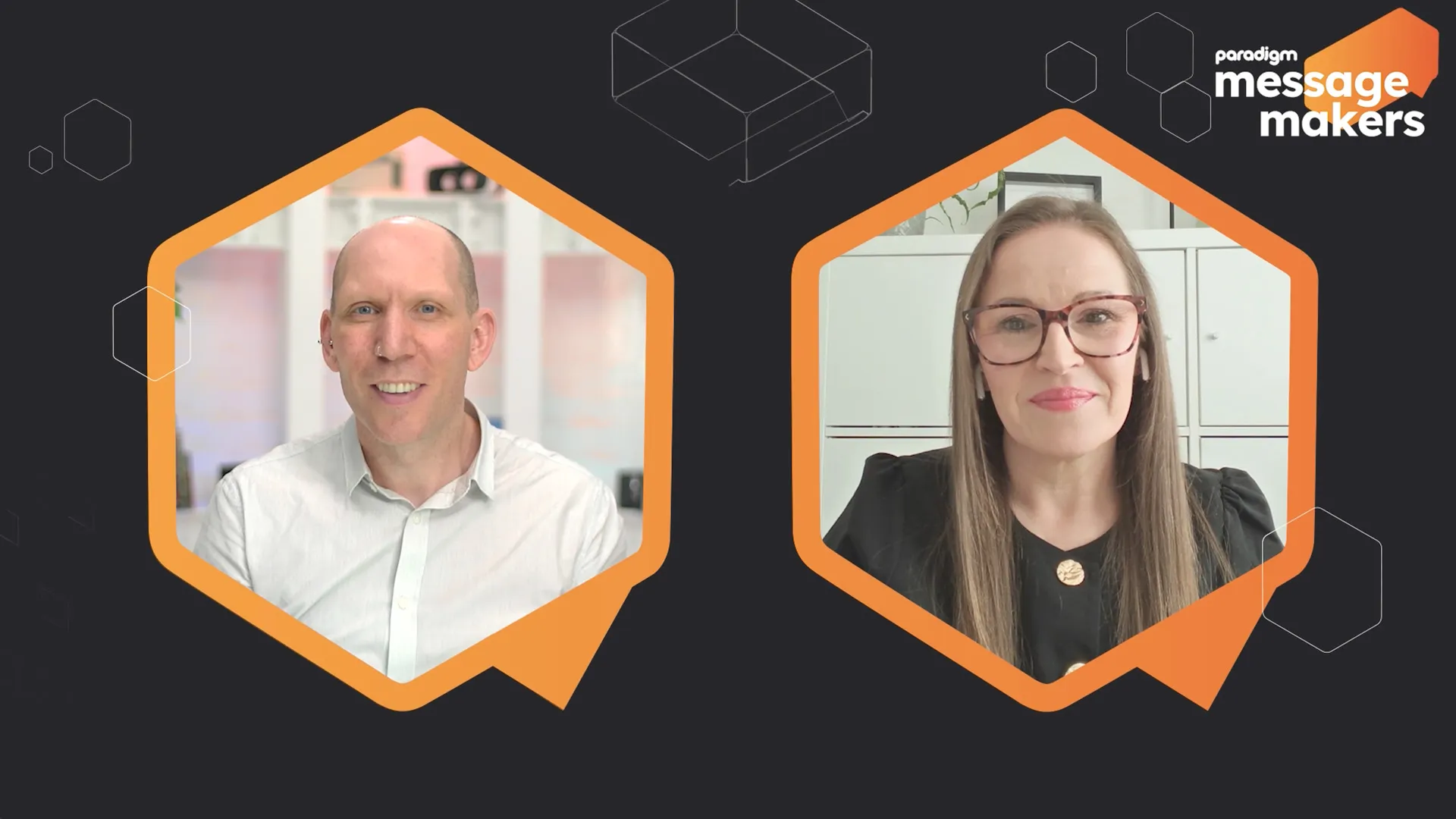
Transcript of a conversation with Owen Vittanuova, Managing Director at Paradigm, and Tracy Goode, International Internal Communications Manager at Fujitsu, on culture, stakeholder relationships, sensemaking, AI, and employee engagement.
Watch or listen on:



Hosted by:
Owen Vitannouva
Managing Director, Paradigm Creative
Guest speaker:
Tracy Goode
International Internal Communications Manager at Fujitsu
Owen:
Hello and welcome to Message Makers. This is where we uncover the knowledge and experience shaping the communications industry. I’m really pleased to be joined today by Tracy Goode from Fujitsu. We’ll be talking about working across cultures, professional development in communications, and building relationships and engagement.
Hi Tracy. You’ve spent a long time in one organisation, but you’ve moved through a number of roles within it. How has that shaped the way you communicate?
Understanding how employees experience communications.
Tracy:
It has given me an appreciation of what working life feels like for many of our employee audiences. I’ve worked in service delivery and marketing, supported HR programmes, worked in legal and commercial roles, and spent time with our engineers. That experience has helped me understand how communications can be received by very different groups of people.
It has also given me a sense of realism. As communicators, we need to recognise that not everything we put effort into sharing will be relevant or interesting to everyone.
I would encourage anyone who has not worked outside communications to find ways to experience other roles. That could mean taking part in day-in-the-life or back-to-the-floor activities, spending time with people in different working environments, and observing how they interact with internal content. It can make a real difference to how you design communications in the future.
Owen:
I couldn’t agree more. I started my career in retail, working in a bookshop, and then moved into a contact centre before going into communications. I think everyone benefits from some experience in retail, hospitality or a contact centre, because the pressures are completely different from those in a more office-based role.
Understanding those pressures, and the limited opportunities some people have to consume content, can fundamentally change how you plan communications. How would you approach that if somebody has not had direct experience of frontline work?
Reaching frontline and mobile employees.
Tracy:
Start by building a strong network. When you interact with people in other parts of the business, look for opportunities to join their meetings or take part in day-in-the-life experiences.
I’ve sat in cars with engineers as they travelled between customer sites, joined them on service calls and visited parts banks where they collect the equipment they need. It is useful to see what they do and how few opportunities they may have to engage with internal communications during the working day.
I have also worked as a service delivery manager. One day I could be supporting a rail account in London, and the next I could be travelling to Glasgow to work with another customer. In those environments, you do not have the same opportunity to sit at a laptop, check the intranet, keep up with emails or join online communities.
That visibility helps you understand why messages need to be shared through multiple channels. Publishing a story on the intranet does not mean everybody knows about it. If somebody has been travelling or working at customer sites for several days, they may never have seen it. You need a schedule that communicates important information more than once and in different ways, so people can encounter it at the touchpoints available to them.
Owen:
Absolutely. We worked with a logistics client where, during the busiest Christmas period, office-based colleagues spent time loading trucks in the warehouse. It helped them understand the process and the pressures people were working under.
The organisation you have spent those years with is Fujitsu, which is headquartered in Japan. What difference does that make to the way you work and communicate day to day?
Communicating across cultures in a global organisation.
Tracy:
Fujitsu has around 113,000 employees, with more than half based in Japan. We are broadly structured into Japan and international operations, with regions, countries and business areas beneath that. It is a very large employee population with many different cultures.
I do not only mean business cultures. People have grown up in different environments, speak different languages and have experienced different education systems. All of those things shape the culture they bring into the workplace. Working across those cultures is interesting, but it can also be challenging. I find myself adapting my communication style every day.
The biggest challenge often comes when a programme involves colleagues across several cultures and we need to find a way of communicating that works for everyone. Our teams in the Nordic countries, for example, often expect company announcements and event information to be available on the intranet. In the UK, preferences are more mixed: some people favour email, some use online communities and others go directly to the intranet.
In Japan, colleagues are generally very respectful of hierarchy and of information issued by corporate headquarters. I also find that I need to slow down when I work with Japanese colleagues. I am naturally lively, ask a lot of questions and speak quite quickly, whereas their working style is often calmer, more deliberate and highly polite.
Japanese colleagues may also prefer more detail. In the UK or Germany, we can be more direct and may need less contextual information. When I communicate with colleagues in Japan, I explain things more fully while keeping the language clear and straightforward. Many of our Japanese and European colleagues speak excellent English, but it is still important to be thoughtful about language differences.
Because Fujitsu is headquartered in Japan and so many employees are based there, people outside Japan often adapt to the Japanese way of working. I might send a UK colleague a quick message asking for an update, but I would usually give a Japanese colleague more context and more time to consider their response. I have become much more deliberate in the way I communicate with different groups.
Owen:
At a surface level, people might assume global communications is mainly about translating content into different languages. When you look more closely, there is clearly much more involved. Have cultural differences ever caught you off guard?
Learning from cultural differences.
Tracy:
I would not say I was caught off guard, but one experience made the challenge very clear. Around 15 to 18 years ago, when I worked in legal and commercial, I helped establish a UK shared service. The team reviewed contracts, extracted obligations and dependencies, and used that information to support contract management. We also worked with an offshore commercial shared service in India.
At first, I had not given enough thought to how it might feel to work across those cultures. In meetings, colleagues would often agree, nod and say yes because they wanted to be helpful and did not want to disappoint anyone. A week later, we would meet again and discover that very little progress had been made.
The leader of the offshore team and I eventually recognised that colleagues did not feel confident or comfortable speaking up. They worried that raising a concern might be seen as failure, challenge or a lack of conformity.
We travelled to India, spent time with the team and ran a series of open workshops. We made it clear that speaking up was not only acceptable but something we actively wanted. We discussed how we could work better together and developed a service improvement plan that helped frame our communication and improve the service. It was one of my first major experiences of how cultural differences can create practical challenges in service delivery.
Owen:
It sounds like a mismatch of expectations and experience. When we spoke before, you mentioned cultural theory and how it can reduce some of that friction and misunderstanding.
Tracy:
It can. I’m studying an MA in Internal Communication Management, and one of the modules has focused on culture. The reading has given me a greater awareness that people are different and work in different ways, and that this is completely valid.
Culture is not only about the organisation. People have grown up in different environments, and understanding that helps me feel more comfortable with my own style while being more accepting of other people’s approaches. Instead of becoming frustrated or confused, I can recognise the difference and work with it. You get the best from each other when you do that rather than expecting everybody to behave in the way you are used to.
One challenge is how quickly you have to switch. I might be speaking with a Japanese colleague one minute and a Portuguese colleague two minutes later. The styles and expectations can be very different, so I am constantly considering the most effective way to interact with the person in front of me.
Owen:
That is similar to stakeholder management. You adapt how you present information depending on the individual, and over time you learn how different stakeholders communicate. This is the same principle applied at both an individual and a cultural level.
Adapting communications to stakeholders.
Tracy:
Exactly. The module I am studying at the moment focuses on influence, trusted adviser relationships and business partnering. It is encouraging us to look at how we adapt our style to the stakeholder we are working with, and then how we shape communications around that stakeholder’s own style.
Internal communicators have a large toolkit: events, written content, newsletters, videos and many other channels. But those tools do not work in the same way for every stakeholder. I have been reflecting on senior relationships that have worked well and others that have been less effective, asking why the same approach succeeded in one case but not another.
What I am learning is that understanding the stakeholder can matter more than demonstrating my own expertise. I am trying to think of myself as an external consultant to that stakeholder, even though we work in the same organisation.
If you entered an organisation as an external consultant, you would ask many questions. You would try to understand the stakeholder’s personality, what motivates them and what makes them comfortable. You would then design the communications around those insights, rather than beginning with your own idea of what a good communications plan should look like.
Owen:
That is one of the benefits of agency work. We go into many different organisations and have to understand them very quickly. Being external gives you permission to ask questions and challenge assumptions: why do you do things that way, or what does that acronym mean? People inside an organisation can start to take those things for granted.
You also mentioned that the Master’s has encouraged you to assess relationships and projects that worked well, not only those that went badly. We often debrief a failure because we want to fix it, but there is just as much value in understanding why something succeeded.
Professionalising internal communications through study.
Owen:
You are studying a Master’s in Internal Communication Management. What prompted you to formalise your communications practice in that way?
Tracy:
Our head of internal communications told the team that he wanted to see greater professionalisation across the function. That prompted me to look at the Institute of Internal Communication and the development opportunities it offered. I joined some free webinars and explored the resources on its website.
Through those sessions, I discovered the MA and discussed it with my line manager. She was very supportive and thought it would be a valuable thing to do. As a first step, I joined the IoIC, completed the application process and became a certified member. That made me think more seriously about pursuing the Master’s.
At around the same time, I was having conversations with my children about college and university. My older daughter is now studying law, and I attended some sample lectures with her. Seeing education again through the eyes of an adult made me realise that studying could feel very different from the experience I had at 18.
I applied for the course, submitted a portfolio of work and was interviewed by the course director before being offered a place. Combining the programme with a full-time job and a family of mixed ages is hard work, but it is extremely interesting.
I use ideas from the course all the time. In weekly one-to-ones with my line manager, I frequently mention something I have read, and she does the same with me. We discuss subjects such as sensemaking and how they apply to the activities we are working on.
I cannot simply reuse assignments from the course, but I can adapt the learning. I have taken ideas from Karl Weick’s sensemaking theory, including how identity shapes the way people interpret information, and turned them into presentations for the team. Colleagues can then use those ideas in their own work and with their stakeholders. The learning is helping to professionalise more than just my own practice.
Owen:
So the main motivation for doing the Master’s was really trying to finish one before your daughter does?
Tracy:
Yes, I am quite keen to complete mine before she completes hers.
Turning instinct into structured practice.
Owen:
Many communicators rely on instinct and previous experience. We often feel our way through a challenge based on what has worked before. Has the Master’s validated that instinct, changed it or altered the way you plan a campaign?
Tracy:
It has given me access to formal models. I probably followed many of the same steps already, but I had not always recognised that they formed a defined structure. You develop an instinct to consider the audience, segment people and think about the process a message needs to move through. The models help you examine those decisions more clearly and at different levels.
One simple example is Bill Quirke’s ‘think, feel, do’ model. It prompts you to ask what you want people to understand from a message, how you want them to feel and what you want them to do.
Another useful framework is awareness, understanding, belief and action. It helps you recognise that not everybody needs the same depth of information. A global intranet story might create general awareness, while a smaller audience may need much more detail because they are expected to take action. The framework helps you think clearly about each audience, the outcome you need and the most appropriate communication for them.
Owen:
Has there been a moment when one of those theories or frameworks helped you make sense of a specific workplace challenge?
Tracy:
The assignment I am working on now is focused on stakeholder relationships and stakeholder management. I am still researching it, but I can already see things I could have done differently in previous relationships and would approach differently in the future.
I cannot go back and change how I or a stakeholder behaved, but I can carry the learning forward. I can apply techniques around influence and use them to build more effective relationships in the future.
Owen:
That stakeholder-management piece is critical. You can have the best communications plan and the strongest ideas in the world, but they achieve very little if you cannot bring the stakeholder with you.
Building trust through stakeholder relationships.
Tracy:
Stakeholders also need to feel comfortable with what we ask them to do. We may want them to appear at a town hall, record a video or speak in front of a room, but not every senior leader is a naturally confident speaker.
Some people communicate much more effectively in writing. They may be comfortable producing a blog because they have time to think, prepare and structure their message, rather than being put on the spot. That is completely acceptable.
The communicator needs to understand what works for the stakeholder and what drives them. You can then support them in delivering their message in a way that works for the wider audience, while business partners tailor the content further for local employees.
Owen:
Sometimes stakeholder management also means saying no. People often believe they are excellent communicators, and the business partner may need to explain that a proposed approach is not the right one. Being able to say no constructively, particularly when you can support your advice with evidence, is an art in itself.
Tracy:
Evidence is extremely useful. Research and reports from organisations such as the IoIC, the IC Index and Gallagher’s State of the Sector give us data we can use with senior stakeholders. That moves the conversation beyond ‘this worked for me before’ or ‘my instinct says we should communicate this way’.
For example, recent research has suggested that more than half of employees have lost trust in their chief executives. Being able to show a CEO that evidence creates a much stronger case for taking action to rebuild trust. Data and established models help stakeholders understand what is happening in other organisations and why a different approach may be needed.
Owen:
That combination is powerful: organisational data helps explain what is happening in your own business, while models and external research support the theory. It means neither the stakeholder nor the communicator has to rely on gut feeling alone.
Helping employees make sense of change.
Owen:
You mentioned sensemaking earlier. For anyone unfamiliar with the concept, what does it mean?
Tracy:
Sensemaking is associated with Karl Weick and includes seven properties: identity, retrospection, enactment, social context, extracted cues, ongoing activity and plausibility. Together, they describe the journey people go through when they receive new information or experience change.
A stakeholder may have a particular frame for a message and a clear idea of what they want to communicate. The communicator needs to pause and consider the audience’s frame as well. How will employees receive the information, and what meaning will they attach to the language being used?
When people encounter certain words or phrases, they automatically connect them to previous experiences. If they hear ‘cost efficiencies’, for example, they may remember that the same phrase was followed by redundancies in the past. Before they have read or heard the rest of the message, their attention may already have moved to what they fear could happen next.
That means we must be precise and deliberate about language. We also need to remember that not communicating sends a message. When people hear nothing, they still try to make sense of the silence. They may remember what silence meant last time and use that experience to predict what is happening now.
Two-way dialogue is therefore important. Whether a message is easy or difficult, people need opportunities to ask questions, interact and build understanding. They may not be ready to respond immediately, so it helps to give them time to reflect and revisit the subject. As the questions change, you can begin to see how their understanding is developing.
Sensemaking is ultimately about recognising the stakeholder’s frame, the audience’s frame and the possibility that the same message will be interpreted very differently by each group.
Owen:
The point that silence is also communication really resonates. We have supported clients through mergers and acquisitions where legal restrictions meant they could not share certain information. In one case, we created content explaining ‘gun jumping’, the legal term for communicating or acting prematurely during a merger process.
The message was essentially that we could not provide more detail at that stage, but we could explain why. Without that context, silence would have created gossip and rumours. Filling the space with an honest explanation helped people understand that information was being withheld for legal reasons, not because decisions were being made in secret.
Tracy:
That communication probably felt authentic because you were honest about what you could and could not say. You set expectations, explained the reason and gave people a sense of the timeline. That is far better than saying nothing.
Sharing learning across communications teams.
Owen:
You have talked about bringing ideas from the course into conversations with your manager and sharing the learning more widely. Have you noticed a difference in how your team communicates as a result?
Tracy:
I think people are becoming more mindful of how they communicate. They are taking a step back to consider how a message will work across different groups and cultures. Much of it is about awareness.
Many people enter internal communications from another discipline, or begin by handling communications as one part of a broader role. Giving them access to established tools and techniques means they can apply those ideas with their stakeholders.
Our team includes junior communications colleagues as well as experienced strategic advisers who work directly with chief executives. Different parts of the learning may be more useful at different career stages, but even for experienced professionals, the models can act as a valuable reminder of approaches they can use.
Learning from peers across industries.
Owen:
One thing I enjoy about agency work is seeing that organisations in very different industries often face the same challenges. The details may vary, but the underlying issues are remarkably similar. You are studying alongside communicators from other sectors. What has that taught you?
Tracy:
I have learned that we experience many of the same difficulties. That is not necessarily a good thing, but it is comforting to know you are not alone.
I have been at Fujitsu for nearly 27 years, so most of my professional experience has been within one organisation. I have not always had a clear view of what life is like for communicators elsewhere. The cohort has shown me that similar challenges arise regardless of an organisation’s size.
I may be the only person in the group working in an organisation as large and globally distributed as Fujitsu. Others are the sole internal communicator in their organisation, work in teams of 40 or 500, or operate in public-sector environments with around 6,000 employees and significant regulatory constraints.
The contexts differ, but we still ask many of the same questions: how should we use technology, and how do we engage remote employees? It is reassuring to discover that these are shared challenges.
Owen:
That is one reason we created this podcast. It gives people an opportunity to look beyond their own organisation and see that they are not the only ones facing a particular challenge. Communicators are often very generous with their experience and knowledge, and sharing what has worked elsewhere can help people improve their own practice.
Tracy:
Our cohort has already discussed how we can stay connected after the course because the community has become valuable. Alongside tutor-led sessions, we have informal conversations, breakout groups and collaborative work. People actively share content and ideas, and I hope we can continue that exchange in the future.
Using AI to strengthen internal communications.
Owen:
To finish, I have a few quick closing questions. What do communicators need to improve over the next five years?
Tracy:
We need to work out how to make the best use of artificial intelligence. Fujitsu’s Technology and Service Vision places a strong emphasis on becoming AI-enabled, and it is something we have been exploring internally for some time.
I use Copilot regularly, and we also have an internal Fujitsu AI tool. These tools can support writing, editing and research, helping us work more efficiently at different stages of the communications process.
I am not advocating for AI to replace the human role in communications. Its value is in supporting us and helping us complete certain tasks more quickly. We need to understand how to embed it into processes so that they become smoother and more efficient.
Used well, AI can free internal communicators to spend more time on strategic stakeholder relationships and on building richer relationships with employees. We need to master the art of using AI without losing the human judgement that makes communications effective.
Owen:
AI cannot yet manage an active stakeholder relationship, although perhaps it will get there one day.
Making communications faster and more digestible.
Owen:
What excites you most about the future of internal communications?
Tracy:
We have many channels and an enormous amount of noise. Employees do not always know where to go for a particular piece of information because so much content is available. I experience that myself sometimes.
We need to find quicker, shorter and sharper ways to communicate, making information faster to access and easier to digest. Internal communications should reflect more closely how people consume information outside work and at home.
I am interested to see how employee apps and other technologies develop, including tools we may not yet know about. There is a real opportunity to make workplace communications more intuitive and relevant.
Owen:
Consumer technology and consumer channels often move faster because they are less constrained by corporate IT frameworks, procurement and security. We work across internal communications, employer brand, marketing and social content, and there is real value in taking formats that work externally and applying them internally. The technology can be a limiting factor, but the underlying ideas and formats can still be very effective.
Tracy:
There is much more to come for employees. Consider how rapidly technology changed the way we communicate during and after the pandemic. We no longer need to travel for hours for every meeting; we can join remotely and begin immediately. Only a few years have passed since 2020, yet the way we work has changed enormously.
Owen:
This recording is a good example. Before the pandemic, we might all have travelled to a studio. That would have been enjoyable, but it would also have made the process slower. There was a popular observation that ten years of digital transformation happened in the first three months of 2020, and it certainly felt that way.
Starting with stakeholder understanding.
Owen:
Finally, if there is one thing you hope listeners take from your experience, what would it be?
Tracy:
Understand your stakeholder. Internal communications professionals rightly spend a great deal of time thinking about employees and audiences, but we should not underestimate the need to understand the stakeholder equally well.
We cannot support a stakeholder or the business strategically until we understand their real drivers. Build that relationship at the top, and the quality of the communication that reaches employees will improve as a result.
Owen:
That is an excellent place to finish. Thank you for joining us, Tracy. It has been a really interesting conversation, and I have thoroughly enjoyed it.
Tracy:
Thank you for the opportunity and for inviting me. It has been lovely to talk.
Owen:
That’s it for this episode of Message Makers. Thanks again to Tracy for joining me and sharing her insight. Do not forget to subscribe on the platform of your choice, and if you have any questions or suggestions for future topics, please get in touch.