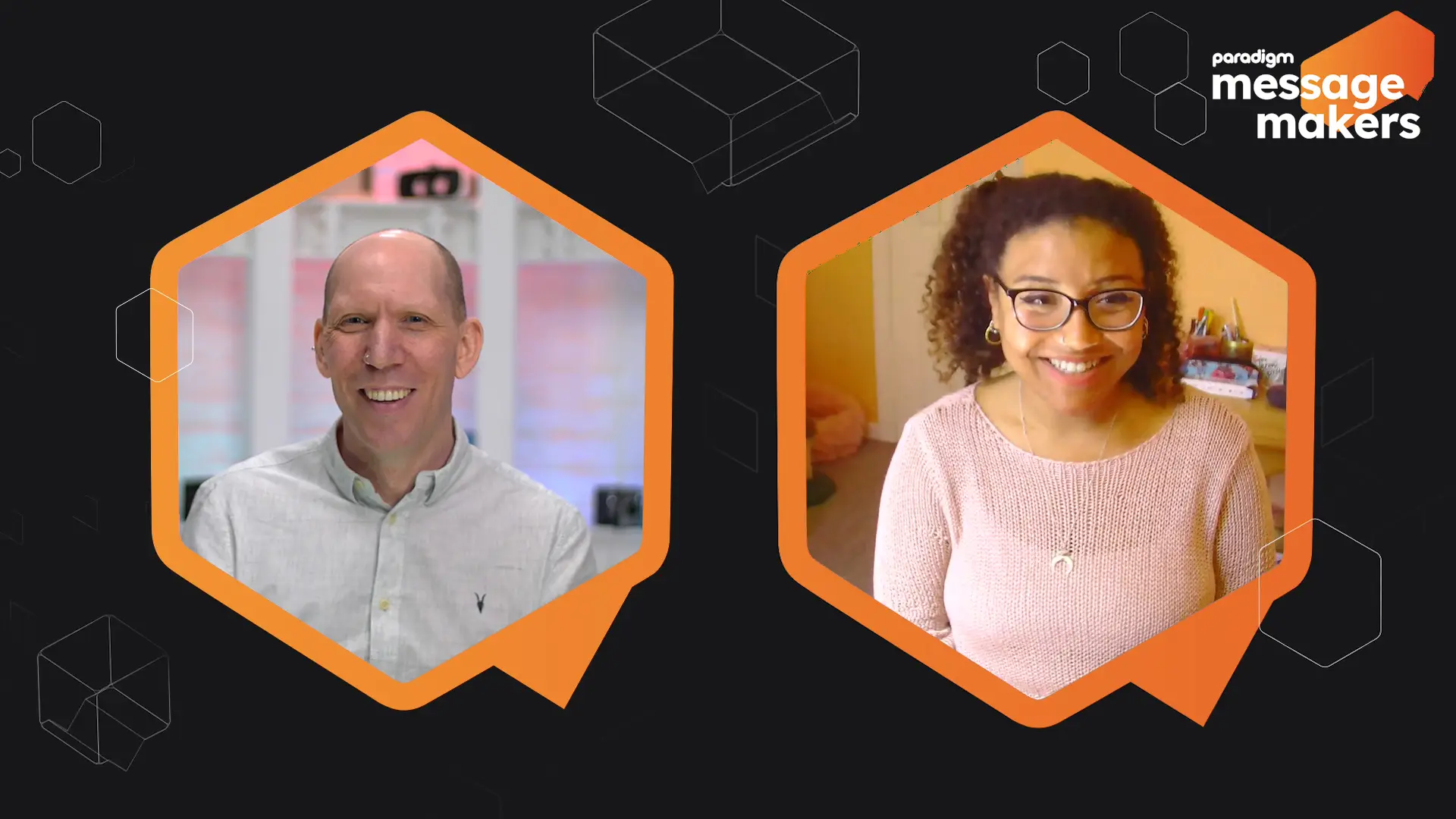
Transcript of a conversation with Owen Vittanuova, Managing Director at Paradigm, and Sasha Cornelius, Global Communications & Engagement Manager at Kantar, exploring AI adoption, measurement, engagement, and large-scale change.
Watch or listen on:



Hosted by:
Owen Vitannouva
Managing Director, Paradigm Creative
Guest speaker:
Sasha Cornelius
Global Communications & Engagement Manager, Kantar
Owen:
Hello and welcome to Message Makers, the podcast that brings to life the experience and insight from across the communications world. Today I'm talking to Sasha Cornelius from Kantar. Thanks for joining us, Sasha. To start, tell us a little about your role at Kantar and what it looks like today.
Driving AI adoption across a global workforce.
Sasha:
I work in the global culture and engagement team, so my role is mostly focused on internal communications, but it is also about making sure people feel part of a bigger whole. My current focus is mainly on our digital transformation, and this year I'm also picking up other change initiatives because there is a lot of change happening across the business.
What I'm mostly going to talk about today is our digital transformation work from last year, specifically rolling out Microsoft Copilot and getting the entire business involved in using AI day to day.
Owen:
For people who might know the Kantar name but not necessarily know the organisation, can you tell us a little about what Kantar does, who works there and the size and shape of the business?
Sasha:
Kantar is a data analytics and market research company. We gather consumer data in many different forms and use it to help brands understand how to perform better: how to sell more, how to market themselves and which customers to focus on. The majority of people at Kantar are researchers, and they tend to be very detail-oriented and consultative in their approach with clients.
We currently have around 15,000 people. When we started this work at the beginning of 2025, we had a few more. I like to say Kantar is like lots of tiny companies standing on each other's shoulders in a trench coat. There are many different personalities, attitudes and types of people that we have to consider when we're communicating across the whole organisation.
Owen:
There's a specific campaign we're going to talk about: rolling out AI tools across the entirety of Kantar. It wasn't simply about how the communications team could use AI; it was about how the whole business could use it. What was the rationale, and how did you approach it?
Sasha:
We have a partnership with Microsoft, which gives us a number of benefits, and we're a Frontier Firm, so we often get earlier access to new features, particularly with Copilot. The long-term goal is to embed AI into the products and services we offer to clients.
To do that, we need every person in the company to become comfortable using AI. Our ambitious goal for 2025 was 80% adoption by the end of the year. We reached that target by May, and our adoption rates, once you account for things such as annual leave, have since been consistently around 80-90%. The goal was to make people genuinely comfortable using AI in their day-to-day work.
Overcoming hesitation around AI adoption.
Owen:
When you started the campaign, what barriers did you face? Were people sceptical, and were there concerns around areas such as legality and data protection?
Sasha:
There was a lot of hesitation. Most of the questions we received were about data protection, legality and accuracy: is the technology actually good enough? We adopted Copilot relatively early in its development, and there were times at the beginning when it wasn't very good, which was a difficult hurdle to overcome.
One way we addressed that was by working directly with consultants at Microsoft. A lot of our initial focus was on teaching people how to converse with Copilot in a way that would produce better results. We also worked closely with our legal and data security teams, as well as Microsoft, to give people clear answers about what happens to their data.
The resistance was mainly around accuracy, privacy and legality, which makes sense for researchers and consultants. They have a duty of care to clients, particularly when they're working with client data, so of course they're going to ask those questions.
Making AI practical for different roles.
Owen:
A lot of conversations about AI stay at a very broad level, but you quickly moved towards practical use cases and specific tasks. How important was that, and how did you work out which use cases mattered to different audiences?
Sasha:
When you're speaking to a community of thousands of researchers, you don't necessarily want to tell them to use AI to do their research for them. The challenge is finding where the real value sits. Very early on, after our initial introductory training, we realised we needed to separate the programme into personas and job roles.
The backbone of our training plan was something we called Power Half Hours. We ran them every Tuesday throughout the year, apart from a short break over the summer. They started with the basics: how to craft a good prompt, how to get a useful response and how to talk to large language models. Many people had learned how to search Google using keywords, Boolean searches and quotation marks, so conversational prompting required a real mindset shift.
We also had highly engaged champions and influencers, and they were essential. We could ask them: what have you used Copilot for this week? Where have you saved the most time? What repetitive task do you have to do every week as part of a client project, and how could we simplify it or use Copilot to make your working life easier?
Building adoption through training and champions.
Owen:
Those Power Half Hours sound like the backbone of the campaign. What else did you build around them?
Sasha:
The Power Half Hours were weekly, 30-minute training sessions. We ran two sessions to cover different time zones and made every session available on demand afterwards. We're now working on an agent that contains all of that content, so if someone can't remember how to do something in Excel, for example, they can ask the agent and it can direct them to the relevant Power Half Hour and the exact point in the recording where that topic was covered.
We also had influencers across the organisation because we wanted every country and every large team to have somebody who could act as a resident Copilot expert. They received additional training, support and engagement from the central team.
We created a Viva Engage community called Copilot at Kantar. Microsoft provides suggested content, such as new features, how-to guidance, videos and other training materials, but the community also became a place for questions and answers. The central team was small - essentially me and two technical business partners - so we couldn't keep up with every question ourselves. The influencers started taking the lead on responses, and the community is now much more self-sufficient.
We also had adoption leads: more senior people with responsibility for encouraging Copilot use within their teams. They helped us create and share agents, which are essentially more focused versions of Copilot with specific instructions for a particular task.
Data was another important part of the programme. We pushed Microsoft to give us a more detailed view of adoption so that we could segment usage by country, team and job role. That data helped us understand when we needed to pivot. As we introduced more bespoke sessions, for example, we could see an increase in usage among client service teams after a client service-focused session. It gave us a much clearer picture of what was working and what wasn't.
Measuring AI adoption and its impact.
Owen:
It sounds as though you were able to measure outcomes in quite a detailed way. What did the data show about the impact of the campaign?
Sasha:
At the end of 2024, we had a pilot cohort using Copilot. We surveyed them about the tasks they were using it for, how long those tasks had taken before Copilot and how long they took afterwards. That became one of our first key metrics because it gave us an indication of the potential time savings, and therefore the potential financial value, across the business.
The average time saving was around two hours per week. For people we classified as master users, the saving was between 3.1 and 10 hours per week, which is significant. When we scale that across the organisation, we've calculated an average saving of around 24,000 hours every week.
We also have a dashboard showing how people are using Copilot. We define a master user as somebody having more than 20 Copilot conversations per week, rather than counting every individual prompt, because a single AI conversation can involve a lot of clarification. Below that, we can see regular users, low users and non-users. The data is provided in a way that protects privacy, so we can't see individual usage.
Making AI adoption feel human.
Sasha:
We also ran AI activation days, which were much more personalised to people's job roles, markets, countries, offices and ways of working. Our technical business partners travelled to different locations for full-day sessions, although we ran some remotely where necessary. The starting point was always practical: what task do people in this office need to do, and how can we improve it?
That personal touch mattered because conversations about AI can quickly become intimidating. People worry that robots are going to take over or that AI is going to replace their jobs. Having a human presence helped reassure people, get them engaged and make the experience feel more positive.
Sometimes you also need to bring in an element of fun - cupcakes, bunting, whatever works. You're asking people to step away from their day-to-day work and invest time in learning something new, so it's important to show that the organisation is giving them permission to do that.
We worked closely with local influencer teams and asked, what do your people need? Not, what do we think is best for you? We could see that the areas with highly engaged adoption leads and influencers performed better. People would come to us saying they'd discovered a new use case or had run a hackathon locally, and those were the places where we saw the strongest movement in the analytics.
Creating a global AI Festival.
Owen:
The culmination of the campaign - and my personal favourite part - was the AI Festival. What was the ambition, what was the scope and what impact did it have?
Sasha:
It was definitely my favourite part too. I love a big event. The AI Festival came from a few different needs. Our CEO at the time liked to create a big global moment once a year to bring people together and make them feel part of One Kantar, because the organisation can sometimes feel fragmented.
We were also reaching a turning point in the digital transformation. For a while, people could feel as though we were using Copilot simply for the sake of using it. We needed to make the message clearer: why are we doing this now, and what are we evolving towards in the future?
We had also seen the success of the AI activation days in individual markets, but there were some places we couldn't reach in that way. We wanted to replicate that experience on a bigger scale and involve the entire company.
The initial request was for a one-day event, but leaders told us they couldn't take people away from their work for a full day. We therefore took roughly one day's worth of content and spread it across three days. Not every session was relevant to everybody, and we had an international workforce to consider, so we split the programme into short sessions. The absolute maximum was 45 minutes, and most were around half an hour, with breathing space between them.
Paradigm worked with us on the event and helped solve a lot of those production and delivery challenges. We had three main days of activity, plus a build day beforehand. The production was fantastic, people were highly engaged and it became one of the highlights of the year for many of us. We've also submitted the work for awards and had some success with that.
Combining global production with local participation.
Owen:
Alongside the sessions broadcast from London, there was local activity taking place around the world. It wasn't simply a broadcast push. Wherever people were in the company, they had opportunities to interact face to face locally while also sharing a global experience.
Sasha:
That was one of my favourite parts of putting it together. We had contacts in local offices - executive assistants, culture and engagement colleagues, marketing teams and simply enthusiastic people who volunteered to help make something happen locally.
Alongside the central broadcasts, we gave those teams a pack of ideas they could use. In India, for example, people had illuminated AI Festival letters, backdrops and lots of decoration. In some other countries, it might simply have been bunting and cupcakes. The important thing was that it felt fun. It didn't need to have high production values; we wanted people to come together, talk about AI and take part in practical activities.
Those activities included hackathons, where teams came together around a shared problem and tried to solve it using technology, and prompt-a-thons, where people shared prompts that had worked for them and improved them collectively. In Porto, one team created an AI-themed escape room using quiz questions and Copilot prompts to unlock the next stage. It was brilliant to see that creativity come to life.
The whole experience felt very different from anything Kantar had done before. We had previously run an event called Follow the Sun, which moved through the time zones from east to west. The AI Festival felt more like everybody was online and participating together. We created a separate Viva Engage page where people could post photos and videos in real time, which gave the event a genuine community feel.
A lot of Kantar content is deliberately corporate and clean - white backgrounds, black text and touches of gold. For the Festival, we told people to go much further with it. They did, and the result was something much more energetic and playful while still feeling recognisably Kantar.
Using data to evolve the programme.
Owen:
What did the data show after the Festival, and how has the campaign evolved since then?
Sasha:
After the Festival, the data showed a higher proportion of master users, a higher adoption rate and more people using Copilot habitually. That was reassuring because it showed the activity had translated into behaviour change.
This year, we've also seen people asking more difficult questions. Through Viva Engage, live training sessions and our annual employee survey, we're hearing more about the environmental and social impact of AI, including concerns about data centres and the wider impact of the technology.
We need to address those questions rather than ignore them. Someone recently asked us on Viva Engage to stop encouraging people to use AI just for fun because of their concerns about its environmental impact. We discussed that with our technical business partners, legal team and environmental, social and governance colleagues, and agreed that it was a fair point.
We've also stripped back the Power Half Hours because people are under pressure in their roles and attendance was starting to drop. The programme is now less about teaching everybody the basics of Copilot and more about creating strong agents that support specific processes. Some of that requires greater process standardisation, so we're working with other teams on that, and we're already seeing an impact in areas of client work where a clear process is now supported by an agent.
Lessons for leading large-scale AI change.
Owen:
If somebody wanted to take this approach and run a similar technology adoption or change programme, what lessons would you pass on?
Sasha:
The first lesson is to think carefully about the timing of your key events. When you're in a communications team or another support function, you can sometimes feel detached from the rhythms of the rest of the business. Before you plan something big, ask people around the organisation whether the timing actually works for them. Sometimes you won't have a choice, but you should ask the question.
Second, personalise as much as possible. For technology adoption, or any change programme, think about the different personas across the business and what they specifically need. It takes more time and more energy, but it's worth it.
Finally, don't underestimate the importance of the human element - and of play and fun - when you're helping people learn and engage with something new.
Owen:
That's a great place to end. I've really enjoyed the conversation and I appreciate you sharing so much of the thinking behind the campaign. What stands out for me is the consistent measurement: being able to see the impact of what you were doing in real time and use that evidence to keep improving the programme. Thank you so much for joining us, Sasha.
Sasha:
Thank you for having me. I could honestly talk about this for years, so apologies to your editor who has to cut some of it down. I've had a great time, and I'm always happy to talk about it.
Owen:
And that's it for this episode of Message Makers. Thanks to Sasha for joining me and sharing her experience. If you've got questions, ideas or suggestions for future guests, we'd love to hear from you, and we'll be back soon with more Message Makers.